samedi 4 juillet 2026

Keiko Fujimori declared winner of Peru's presidential election weeks after vote

by


 Right-wing candidate Keiko Fujimori has been declared the winner of Peru's tight presidential election, nearly a month after the vote took place.

The 51-year-old won 50.135% of voters' support in the runoff, held on 7 June, to 49.865% for left-wing candidate Roberto Sánchez - a margin of less than 50,000 votes, figures certified by Peru's electoral court show.

It is the fourth time the daughter of disgraced former President Alberto Fujimori has sought the South American nation's presidency, promising this time to oversee a crackdown on organised crime.

Her election, coinciding with the election of Abelardo de la Espriella in Colombia, marks a shift towards the right in Latin American politics.

Fujimori said she would assume the role of president "with responsibility, humility and a deep sense of duty".

"Each day of this transition process is an opportunity to listen, engage in dialogue and arrive prepared at the start of the new government," she added, with what appeared to be a nod to her thin mandate.

Sánchez, 57, has alleged the runoff election had been "seriously compromised" and threatened legal action, arguing that strong support for Fujimori among Peruvian voters abroad was a sign of irregularities.

After the result was declared on Friday, his party appealed against the electoral court's proclamation, calling for the vote to be nullified.

While Sánchez, a former foreign trade minister, stood on a platform of broad economic reforms, Fujimori benefited from concerns over crime and political instability dominating the race.

Throughout the campaign, she leant on the controversial legacy of her father, promising a military crackdown on organised crime, in particular extortion incidents that have soared in recent years.

Alberto Fujimori was eventually jailed for crimes against humanity over extra-judicial killings and forced sterilisations undertaken during his increasingly authoritarian leadership.

Keiko also pledged to attract private investment to promote economic growth and to immediately expel any undocumented immigrants found to be committing crimes in Peru.

She stood unsuccessfully in 2011, 2016 and 2021, losing by similarly tight margins, during a period of intense political instability in Peru. She will become the Andean country's ninth president in a decade.

Her swearing-in ceremony is expected to take place on 28 July.

When she assumes office, she will be the latest addition to a host of ideologically aligned, right-wing leaders in Latin America who have assumed power in recent years, often unseating left-wing governments.

Colombia's president-elect, de la Espriella, will take office a few days later, having won a similarly razor-thin election on the promise of combatting organised crime.

He and others like El Salvador's Nayib Bukele and Ecuador's Daniel Noboa have sought to align themselves with US President Donald Trump, who has taken more of an interest in Latin American political affairs in his second term.

The trend means Brazil's Luiz Inácio Lula da Silva - who is facing the son of convicted former president Jair Bolsonaro in elections later this year - is now the region's predominant left-wing standard-bearer.


Injury ends Williams' Wimbledon comeback

by


Serena Williams was playing at her first Wimbledon since 2022

By
BBC Sport tennis news reporter
  • Published

Serena Williams has pulled out of her planned Wimbledon doubles appearance with older sister Venus because of a knee injury.

The American pair, who are six-time doubles champions at the All England Club, were scheduled to reunite on a Grand Slam court for the first time since 2022 later on Saturday.

However, 44-year-old Serena Williams is not fit enough to play after picking up a knee problem during her defeat by Australia's Maya Joint on Tuesday.

The 23-time Grand Slam singles champion did not speak to the media following the match, with Wimbledon organisers saying she was "not able to undertake" her duties.

"I'm heartbroken to have to withdraw from doubles," said Serena in a post on Instagram, external.

"Coming back to compete again has been a gift, and the opportunity to play alongside Venus once more meant the world to me.

"I did everything I could to be ready, but unfortunately my knee just isn't ready to compete."

Figure caption,

Can Serena continue comeback beyond Wimbledon?

Williams' hopes of playing in Saturday's doubles looked to have improved after their match was added to the order of play on Friday.

Their tie, against Colombia's Camila Osorio and Argentina's Solana Sierra, was not allocated a court and not due to be played before 16:30 BST.

It suggested Williams was being given as long as possible to declare herself fit after her knee swelled up during a gallant three-set loss to 20-year-old Joint.

The loose plan also left Wimbledon with no scheduling issues in case the American superstars did withdraw.

Williams was due to practise at the All England Club at 16:00 but announced her decision to pull out about 15 minutes before.

In her post announcing the decision not to play, she shared photographs of her wearing bandaging on the left knee and of what she said were syringes used to drain fluid from the area.

"I'm especially grateful to tournament director Jamie Baker and the entire tournament team for giving me every opportunity to play here," said Williams.

"Thank you to the fans after your incredible support and for making this comeback so meaningful.

"All I can say is stay tuned to a city near you."

Williams has not confirmed what her plans for the next stage of her comeback will be.

After Wimbledon, the season switches to the North American hard court swing which culminates at the US Open between 30 August and 13 September.

Prince Harry will not be joined by Meghan and children on London trip

by


 The Duke and Duchess of Sussex had planned to visit the UK with their children from Monday

Prince Harry will not be joined by his wife, the Duchess of Sussex, and their two children when he visits the UK next week, it is understood.

Meghan, Archie and Lilibet will not travel to London, as had originally been planned, after it was confirmed that the family would not be provided with taxpayer-funded police security.

It is still possible that they may join Prince Harry later in the week, when the five-day trip moves to Birmingham to promote the Invictus Games.

It is unclear whether a meeting between King Charles and his two grandchildren, aged seven and five - who he has not seen in person for four years - will take place under the revised schedule.

It had been thought London was the most likely location for any family reunion, after the Duke and Duchess of Sussex accepted an offer to stay in a royal residence with their two children.

The King has a number of public engagements planned for next week. Buckingham Palace is making no comment on private family matters.

The change means Meghan will not join her husband on a visit to the Royal Hospital Chelsea for meetings related to the Invictus Games on Wednesday. Prince Harry will now attend alone.

Discussions are ongoing around the security elements for the later part of the visit but no final decision has been made, it is understood.

There had been reports that the later part of the trip would include a visit to Althorp in Northampton, the family estate of Prince Harry's mother, Diana, Princess of Wales.

It is understood there were plans for Prince Harry to take his wife and children to his mother's private grave.

The visit moves from London to Birmingham on Thursday, when Prince Harry will visit the city's children's hospital to support the work of the charity WellChild, which he has continued to support since his move to the United States.

If Meghan does come to the UK later in the week, she is scheduled to join her husband at Birmingham's National Exhibition Centre to mark the year-long countdown to the venue hosting the Invictus Games.

The decision to pull out of the London element of the visit follows uncertainty over whether the trip would go ahead.

Sources close to the Duke and Duchess of Sussex said the move was down to concerns from Prince Harry's personal security team, which had spent several days reviewing the arrangements.

They also cite the lack of up-to-date assessment from the Royal and VIP Executive Committee's (Ravec) Risk Management Board, which decides on security provision for senior royals and other high profile individuals for the UK government.

A Home Office spokesperson said: "It is our long-standing policy not to provide detailed information on protective security arrangements, as doing so could compromise their integrity and affect individuals' security."

Prince Harry's long-running dispute with the UK government over security stretches back to his decision to step back from his role as a senior royal in 2020 and move to the US with his family.

The prince has contested a decision by Ravec that because he was going to be an infrequent visitor to the UK, his security would be assessed on a case-by-case basis.

He has previously said he would not bring his family to the country without improved security arrangements, telling the BBC in 2025 that he could not "see a world in which I would be bringing my wife and children back to the UK at this point".

Prince Harry and Meghan were last together in the UK in 2022, at the time of the funeral of Queen Elizabeth II.

He has since travelled to the country alone, and met his father on a trip last September.

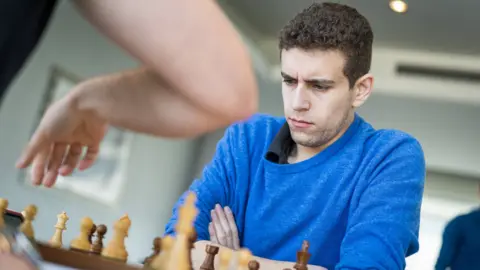
Former chess champion Kramnik banned over cheating remarks

by


 Kramnik has said he will appeal the decision

The World Chess Federation (Fide) has banned former world champion Kramnik for at least a year over verbal attacks he made on other players, including the late Daniel Naroditsky.

The body said it had found Kramnik "responsible for multiple violations" of its ethics and disciplinary code after the Russian accused other players of cheating.

US grandmaster Naroditsky died last October at the age of 29. Before his death, he had denied any wrongdoing and indicated the controversy had taken its toll on him in his final Twitch broadcast.

Kramnik wrote on X that he will appeal his suspension.

Another 12 months of the ban have been suspended for a probationary period of three years, Fide said. It means the active suspension is one year provided no further breaches occur during probation.

Naroditsky was a popular player, teacher and commentator. He was a leading figure in online chess with hundreds of thousands of followers - who knew him as Danya - across Twitch and YouTube.

A toxicology report released in 2026 said he had had multiple drugs in his system at the time and was killed by an abnormal heartbeat caused by an accidental overdose.

Some prominent figures in the chess community - including world number two Hikaru Nakamura, former world champion Magnus Carlsen and Indian grandmaster Nihal Sarin - have previously condemned Kramnik's conduct.

Getty Images Naroditsky sits in front of a chess board with his arms crossed. He is wearing a navy shirt and a blue jumper.Getty Images
Naroditsky had hundreds of thousands of followers across YouTube and Twitch.

Fide said its findings were not intended to determine the validity of Kramnik's remarks, but were concerned with the manner in which the allegations were communicated publicly.

The chess body said combating cheating remained one of its highest priorities, but it stressed that such allegations must be handled through its established procedures.

Kramnik was the world champion from 2000-07 and is a self-declared "advocate for fair play in chess".

Naroditsky earned the title of grandmaster - the international chess federation's highest-ranked chess competitor - while he was still a teenager, after winning the 2013 US Junior Championship.

Ukraine hits major oil terminal in Russia's St Petersburg

by


 Ukraine's military described St Petersburg's oil terminal as "one of the largest" in Russia

A major oil terminal in Russia's second city of St Petersburg in the north-west was struck overnight by Ukraine, President Volodymyr Zelensky has said.

He described it as key "infrastructure that generates revenue for Russia's war". Ukraine also said a major Russian naval base in the region was hit.

St Petersburg Governor Aleksandr Beglov said the city was under a "massive" drone attack, admitting the oil terminal was hit. He reported no casualties.

Ukraine has recently intensified its long-range drone attacks on Russia's critical energy infrastructure, causing widespread fuel shortages. Kyiv says nearly 43% of Russia's oil refining capacity has been "disabled" as a result.

The claim has not been independently verified.

Ukraine says Russian oil and gas facilities are legitimate targets as Moscow relies heavily on fossil fuel exports to continue its war effort.

Russian President Vladimir Putin - who last week made a rare admission of fuel shortages caused by Ukrainian attacks - on Saturday signed into law a bill aimed at boosting supplies to the domestic fuel market.

Putin launched a full-scale invasion of Ukraine in February 2022.

Zelensky said on Saturday morning that the targets hit in St Petersburg and the surrounding region were about 850km (528 miles) from Ukraine's border.

The extent of the damage was not immediately clear, but a video posted by the Ukrainian president showed a drone flying towards a target and a huge column of black smoke billowing from the area after the strike.

The BBC later verified that St Petersburg's oil terminal was hit.

Ukraine's military described the terminal as "one of the largest" in Russia, capable of producing 12.5 million tonnes of petroleum products per year.

The military also said a key naval base of the Russian Baltic Fleet in Kronstadt was hit.

Russia has not publicly commented on the claim.

Governor Beglov said that 72 Ukrainian drones were shot down over St Petersburg and the wider Leningrad region.

He urged city residents to stay indoors until the drone threat was lifted. Mobile internet services might also be disrupted, he warned.

More than five million people live in St Petersburg.

In a separate development on Saturday, Ukraine's military denied that the key eastern Ukrainian town of Kostyantynivka was now under full Russian control.

Military spokesman Maj Andriy Kovalyov told the BBC that "Kostyantynivka remains under the control of the Defence Forces of Ukraine".

He admitted that there were "cases of infiltration by small infantry groups deep into the combat formations of our forces", but added that those groups were being identified and destroyed.

His comments came a day after Putin said that Russian control had been established over the town of Kostyantynivka in June.

The Kremlin leader provided no evidence to back his claim.

Later on Saturday, Zelensky wrote on Telegram: "If Kostyantynivka is now under Russian control, then Putin will probably have no problem meeting me there and finding diplomatic solutions to finally end the war. But still, he will not cross the front line: the truth is very different from Putin's words."

Kostyantynivka is one of several heavily-fortified towns that make up Ukraine's "fortress belt" in the Donetsk region, most of which is occupied by Russia.

In its latest operational bulletin on Saturday afternoon, the Russian defence ministry said it had shot down more than 500 Ukrainian drones and missiles launched overnight and in the morning.

It described the Ukrainian attacks as an attempt by Zelensky to "distract the attention" of Ukrainians and "foreign sponsors" from the consequences of one of the biggest and deadliest Russian strikes on Ukraine's capital Kyiv on 2 July and also a "catastrophic failure" of Ukrainian forces in Kostyantynivka.

Ukrainian attacks on Russian civilian facilities "will not go unanswered", the ministry said.