A father pointed a gun at the people trying to save lives. A SWAT team aimed rifles at a man standing over his motionless son. Doctors had already called in the organ harvesters. But in that silent hospital room, one tiny movement changed everything, turning a tragedy into a miracle.
When doctors said his son was effectively gone, George Pickering II did what no one expected: he became the one-man barrier between his boy and the end.
Surrounded by specialists, paperwork, and “no hope” predictions, he trusted the faint, stubborn instinct in his chest more than any medical chart. That faith pushed him to the edge of the law and into the barrel sights of a SWAT team.
Locked in that room, he demanded one thing the hospital wouldn’t give: time. In those stolen hours, his son’s faint hand squeeze shattered the certainty of the experts. The young man who was written off as a body for organs slowly came back to life. The father went to prison, the son went home—and both now live with the knowledge that a crime, born of love, rewrote a death sentence.READ MORE BELOW
Gov.Greg Abbotthas blocked state agencies from spending money on Flock cameras, but the Texas Department of Public Safety has no apparent plans to stop using its existing roadside surveillance cameras.
As police agencies scramble to adjust to the loss of millions in state grants for Flock cameras, DPS maintains its own far-reaching network of hundreds of AI-powered cameras that compile identifying information on tens of thousands of vehicles each day.
Neither DPS, nor Flock Safety, disclose how many cameras are run by the state agency, though an email shared by a lawmaker on social media shows at least 940 DPS cameras had been installed as of Wednesday.
The surveillance reach of the DPS Flock cameras extends far beyond the agency because its data is shared with thousands of Flock users across the state and beyond.
Once every four seconds, on average, DPS’s surveillance network is accessed by a law enforcement agency somewhere in the United States to search for specific license plates or probe for a vehicle based on its make, model, color or other characteristics, according to a Texas Tribune review of a month of searches.
That analysis of the roughly 615,000 searches using the DPS network in June found:
48% of queries came from outside Texas, including tens of thousands from Florida and Georgia law enforcement agencies that were conducting nationwide searches of Flock networks.
Searches were conducted by 3,075 agencies, 396 in Texas and 2,679 from out of state.
Houston Police had the most searches with 13%, and DPS officers accounted for just under 9%.
More than 58,000 searches were conducted for “traffic infractions,” including some listed for running stop signs or following cars too closely. Other searched categories included auto theft, missing persons and drug offenses.
111 searches listed Homeland Security Investigations, Customs and Border Protection and other immigration-related details, including “ICE deportation warrant,” as reasons for the query.
In July, DPS told the Tribune only law enforcement agencies that signed agreements with the department could access its Flock data. At the time, 206 Texas law enforcement departments had such agreements.
After the Tribune asked why more than 2,800 agencies had searched its network without agreements, DPS said Thursday it will begin limiting access to data from its automated license plate readers, or ALPRs, to agencies with the agreements.
"Law enforcement agencies that did not have signed agreements with DPS could previously access DPS’ ALPR network to look up specific and full license plate numbers only. Moving forward, only law enforcement agencies with signed agreements with DPS will be able to conduct searches of any type to access data and images,” the agency said in a statement.
Asked if Abbott’s directive affected the state police force’s camera network, a DPS spokesperson said it will pause installing additional cameras. But a spokesperson said the agency will continue using existing cameras for a variety of “legitimate public safety efforts.”
Flock camera contracts are a recurring expense, and DPS did not respond to questions about how it plans to fund them long term without state dollars.
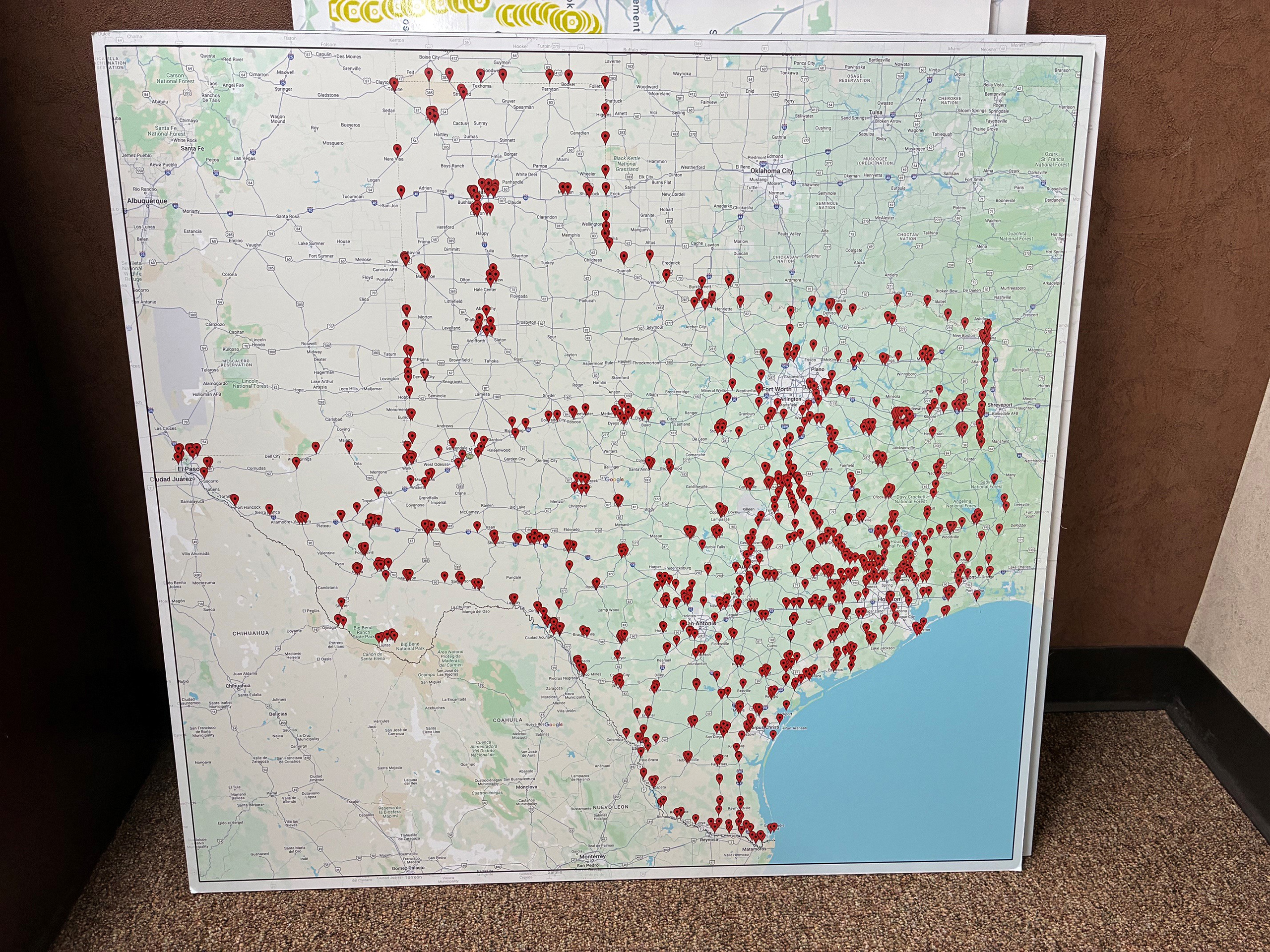
In recent years, DPS has amassed a sweeping network of car-scanning devices along roads leading into neighboring states, along major highways and on state-controlled streets.
A map from the Texas Department of Public Safety presented in January 2025 to the Motor Vehicle Crime Prevention Authority displays proposed Flock camera locations. DPS presented the map, with 1,183 proposed cameras, during a presentation asking the vehicle authority to fund the devices through a $15.9 million contract.
Abbott’s order blocking state agencies from spending money on Flock cameras came Aug. 27, amid the Tribune’s inquiries about a small state agency tapping at least $30 million from a fund dedicated to catalytic converter theft to help pay for at least 3,200 Flock cameras for law enforcement agencies across the state. Six of the seven board members of the Motor Vehicle Crime Prevention Authority are appointed by Abbott.
The authority in early 2025 signed a $15.9 million contract with DPS to fund almost 1,200 cameras.
In addition, the authority agreed in August — before Abbott’s directive — to give DPS an additional $3 million to blanket seven Texas toll roads with 583 more Flock cameras.
Texas is estimated to have at least 13,000 Flock cameras and another 1,000 similar devices, according to DeFlock, an anti-surveillance watchdog that uses verified crowd sourcing to publicize the location of license plate readers.
Texas’ funding block came days before Florida Gov. Ron DeSantis banned all Flock cameras from state highways. Abbott has been less explicit, saying he’s leaving it up to locals to decide whether to take down cameras purchased with state money.
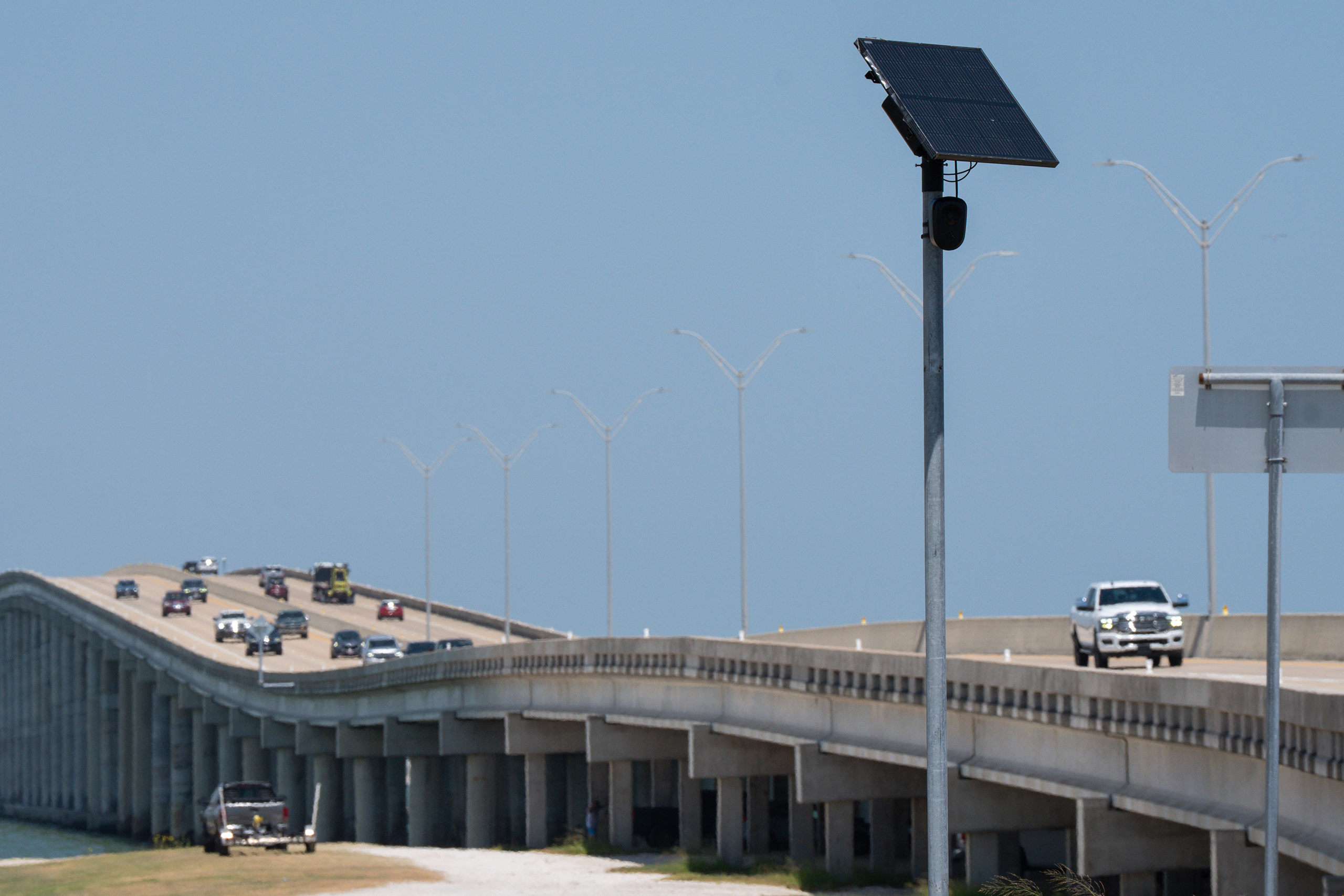
A Flock camera records drivers on the Lyndon B. Johnson Causeway near Rockport on Aug. 23, 2026.
“Most of the money for Flock cameras actually comes from the federal government and is used at the city level, and things like that, and so it’s going to be up to city officials themselves to unplug the Flock cameras,” Abbott said Monday. “However, what has already been observed is that cities across the state are already unplugging from Flock cameras.”
Lawmakers from across the political spectrum have begun pressing Abbott to ban the cameras outright. Abbott’s Democratic opponent in the Nov. 3 election, state Rep. Gina Hinojosa, has blamed Abbott in ads and on social media for enabling “warrantless surveillance” throughout the state.
Hinojosa, D-Austin, said in an interview that DPS and law enforcement should take down cameras because they can be easily abused and were not authorized by state legislators. She’s not completely against the technology, however, arguing that surveillance plays a role with border security.
“If DPS is going to use them along the border for border security, that"s different, but that"s not my understanding of how they"re being used,” Hinojosa said.
Limiting access to state-funded cameras
Agreements allowing access to DPS Flock data outline responsibilities for securely handling the information by local departments and DPS. The state agency clarified Thursday that prior to the new limits on network access, agencies without signed agreements were able to look up specific license plates captured by DPS Flock cameras.
Agencies can also automatically opt in to sharing access to their networks when joining regional or national lookups through Flock. Jacob Herbert, a corporal with the Coweta County Sheriff’s Office in Georgia, told the Tribune that all searches of the DPS network were national in scope and not focused on Texas.
Coweta County’s 6,700 searches in June made it the top out-of-state department to access the Texas cameras.
“Our investigators use nationwide searches when they have a legitimate investigative need to locate a subject or vehicle and do not have sufficient information to limit the search geographically,” Herbert said in a statement. “The purpose is to identify potential leads regardless of where a subject or vehicle may have traveled.”
The Texas Motor Vehicle Crime Prevention Authority agreed to help fund and support the DPS network in part to make it available to police across the state.
“This project — yes, it"s under the Texas Department of Public Safety, but this was done for the locals,” Sharon Jones, a DPS major and former vehicle authority board member, said during a March meeting. “This was done for those agencies in the cities or in the counties who do not have the authority to install cameras on state highways, state roadways. So that"s what that project is for.”
A spokesperson for the vehicle authority told the Tribune in August that it understood DPS required agencies to sign agreements before accessing the cameras they funded.
Local funding in disarray
Vehicle authority grants helped maintain at least 2,000 cameras beyond the DPS network, and Abbott’s directive left dozens of city and county law enforcement agencies scrambling to assess the impact on their camera systems. More than $10.9 million from the vehicle authority to local agencies for 2027 were intended for Flock cameras and software, a review of accepted grants found.
El Paso announced Thursday that it will stop using its 150 Flock cameras — all of which were installed and supported with vehicle authority grants — because of the state funding block. Dallas police also announced Tuesday that they will shut down 321 state-funded Flock cameras paid for with grants from the vehicle authority and an anti-gang initiative.
Killeen police told the Tribune they were still “awaiting any formal guidance” on the future of 76 cameras installed under a vehicle authority grant.
“Until the state provides additional guidance, it would be premature to speculate about whether any cameras will need to be discontinued or whether alternative funding will be necessary,” Killeen police chief Pedro Lopez said in a statement.
The vehicle authority has yet to release public guidance on how its grants or contracts have been affected by Abbott’s order, and its next meeting is set for Oct. 13.
The incident occurred just after midnight on Aug. 26, 2023 when an off-duty police officer with Kyle PD was shot at a San Marcos apartment complex.
The off-duty officer called 911 and said he was working as a courtesy officer at the apartments when he approached then-22-year-old Joseph Sifuentes and a woman after hearing gunshots.
Sifuentes then pulled out a gun and fired two shots at the officer before fleeing to one of the apartments in the complex. He was later arrested by San Marcos police.
The officer who was shot was taken to the hospital, survived his injuries and resumed his duties.
During a court hearing for the case, the prosecution showed evidence that, in June 2023, Sifuentes had driven while intoxicated to Austin with other passengers in the car.
During that incident, he ran a red light before crashing into another vehicle, injuring several people. He then fled the scene and flashed a gun at a bystander.
The prosecution also brought up that, a little over a week before shooting the off-duty officer, Sifuentes pulled a gun on patrons at a restaurant who were waiting for a table.
Sifuentes, now 25, entered a guilty plea and agreed to let the court decide his sentence. Hays County District Court Judge Sherri Tibbe sentenced him to the maximum term of 50 years, emphasizing she wanted to keep the community safe from Sifuentes.
WINDCREST, Texas — A 62-year-old man has been arrested after he allegedly used a hole in an outdoor bathroom wall to photograph people renting his backyard pool.
Joe Anthony Gonzales is accused of possessing or promoting lewd visual material depicting a child, according to an arrest affidavit.
The investigation began on September 2 after a woman told Windcrest police she had rented Gonzales’ pool for a gathering. She said she and her two 7-year-old granddaughters were undressed inside the outdoor bathroom when one of the children noticed someone taking photos through a hole in the wall.
The woman told police she saw hands holding a camera through the opening before the person quickly moved away. A 17-year-old who attended the gathering also told officers she had seen someone’s eyes looking through the same hole while she was changing.
Officers later found an opening where a brick had been removed from the bathroom wall. The other side of the wall was inside a garage, where police found plywood propped against the opening and paint cans nearby.
Gonzales denied the allegations but told a Texas Ranger he was the only person at the home during the pool rental and that no one else had access to the garage. He also consented to a search of his phone, where officers reported finding more than 300 deleted photos, including images and videos of young females.
WINDCREST, Texas — A 62-year-old man has been arrested after he allegedly used a hole in an outdoor bathroom wall to photograph people renting his backyard pool.
Joe Anthony Gonzales is accused of possessing or promoting lewd visual material depicting a child, according to an arrest affidavit.
The investigation began on September 2 after a woman told Windcrest police she had rented Gonzales’ pool for a gathering. She said she and her two 7-year-old granddaughters were undressed inside the outdoor bathroom when one of the children noticed someone taking photos through a hole in the wall.
The woman told police she saw hands holding a camera through the opening before the person quickly moved away. A 17-year-old who attended the gathering also told officers she had seen someone’s eyes looking through the same hole while she was changing.
Officers later found an opening where a brick had been removed from the bathroom wall. The other side of the wall was inside a garage, where police found plywood propped against the opening and paint cans nearby.
Gonzales denied the allegations but told a Texas Ranger he was the only person at the home during the pool rental and that no one else had access to the garage. He also consented to a search of his phone, where officers reported finding more than 300 deleted photos, including images and videos of young females.
Fingers that suddenly turn white, blue, or red may be reacting to more than ordinary cold weather. Dramatic color changes can occur when blood circulation to the fingers temporarily decreases. One possible explanation is Raynaud’s phenomenon, a condition in which small blood vessels narrow and reduce the flow of blood to affected areas.Hospitals & Treatment Centers
During an episode, fingertips may first become pale or white. They can then appear blue before turning red as circulation returns. The hands may feel cold, numb, painful, or tingly. Although the colors can look alarming, the sequence reflects changes in blood flow rather than something that can be understood simply from the skin’s surface.
Cold temperatures are a common trigger. Stepping outside on a chilly day, holding a cold drink, or reaching into a freezer may be enough to begin an attack. Emotional stress can also play a role. The frequency and severity vary greatly: one person may experience mild symptoms a few times a year, while another may have recurring episodes that interfere with daily routines.
Doctors generally distinguish between primary and secondary Raynaud’s. Primary Raynaud’s occurs on its own and is often less serious. Secondary Raynaud’s can be associated with another medical issue, including autoimmune disease, connective-tissue disorders, or vascular problems. That distinction is one reason repeated color changes deserve professional attention rather than an assumption based on a photograph.
Fingers that suddenly turn white, blue, or red may be reacting to more than ordinary cold weather. Dramatic color changes can occur when blood circulation to the fingers temporarily decreases. One possible explanation is Raynaud’s phenomenon, a condition in which small blood vessels narrow and reduce the flow of blood to affected areas.Hospitals & Treatment Centers
During an episode, fingertips may first become pale or white. They can then appear blue before turning red as circulation returns. The hands may feel cold, numb, painful, or tingly. Although the colors can look alarming, the sequence reflects changes in blood flow rather than something that can be understood simply from the skin’s surface.
Cold temperatures are a common trigger. Stepping outside on a chilly day, holding a cold drink, or reaching into a freezer may be enough to begin an attack. Emotional stress can also play a role. The frequency and severity vary greatly: one person may experience mild symptoms a few times a year, while another may have recurring episodes that interfere with daily routines.
Doctors generally distinguish between primary and secondary Raynaud’s. Primary Raynaud’s occurs on its own and is often less serious. Secondary Raynaud’s can be associated with another medical issue, including autoimmune disease, connective-tissue disorders, or vascular problems. That distinction is one reason repeated color changes deserve professional attention rather than an assumption based on a photograph.
The news hit like a gut punch. One moment, a young star is on the brink of greatness. The next, the world is left staring into a silence that feels brutally unfair. Chance Perdomo’s death at twenty-seven doesn’t just break hearts—it shatters the illusion that promise guarantees time. His legacy forces us to reth… Continues…
He left behind more than a filmography; he left an emotional imprint that refuses to fade. On screen, Chance Perdomo carried a rare honesty that made even the smallest moments feel intimate, as if he were speaking directly to the quietest parts of us. Off screen, colleagues recall a man who listened more than he spoke, who treated crew members with the same respect as co-stars, who understood that kindness is its own form of artistry. That quiet integrity is what lingers now, long after the cameras stopped rolling.
His sudden absence exposes how fragile every bright future truly is, but it also sharpens the outline of what he did achieve.
In a culture obsessed with fame, he reminded people that presence matters more than spotlight. The most meaningful tribute is to carry forward what he modeled: empathy, dedication, and the courage to feel deeply. His story may be unfinished, but the resonance of his brief, brilliant life will not fadREAD
The news hit like a gut punch. One moment, a young star is on the brink of greatness. The next, the world is left staring into a silence that feels brutally unfair. Chance Perdomo’s death at twenty-seven doesn’t just break hearts—it shatters the illusion that promise guarantees time. His legacy forces us to reth… Continues…
He left behind more than a filmography; he left an emotional imprint that refuses to fade. On screen, Chance Perdomo carried a rare honesty that made even the smallest moments feel intimate, as if he were speaking directly to the quietest parts of us. Off screen, colleagues recall a man who listened more than he spoke, who treated crew members with the same respect as co-stars, who understood that kindness is its own form of artistry. That quiet integrity is what lingers now, long after the cameras stopped rolling.
His sudden absence exposes how fragile every bright future truly is, but it also sharpens the outline of what he did achieve.
In a culture obsessed with fame, he reminded people that presence matters more than spotlight. The most meaningful tribute is to carry forward what he modeled: empathy, dedication, and the courage to feel deeply. His story may be unfinished, but the resonance of his brief, brilliant life will not fadREAD
.png)



.png)
.png)


.png)


.jpg)


